In short
- The problem
- To find the best ride you open several apps one at a time, at the kerb, often at night, while the prices move.
- My role
- Self-initiated. I did the research, the mobile design, the design system and the prototype myself.
- Evidence
- 16 public sources, including the London private hire law, TfL guidance, provider terms and a study of how people hold their phones.
- Key decision
- Book only through partners and hand everything else to the right app, because the law and the largest provider’s terms rule out booking for every app. One pick, one reason and one button under the thumb.
- The trade-off
- Fewer rides it can book outright, in return for never booking a ride it cannot stand behind.
- Status
- A concept with a playable phone prototype. A hypothesis, not yet tested. Next: five riders at a station, timed against booking by hand.
A concept built on public sources, with a playable phone prototype. The providers, prices and drivers in it are made up. The design has not been tested with riders.
Contents
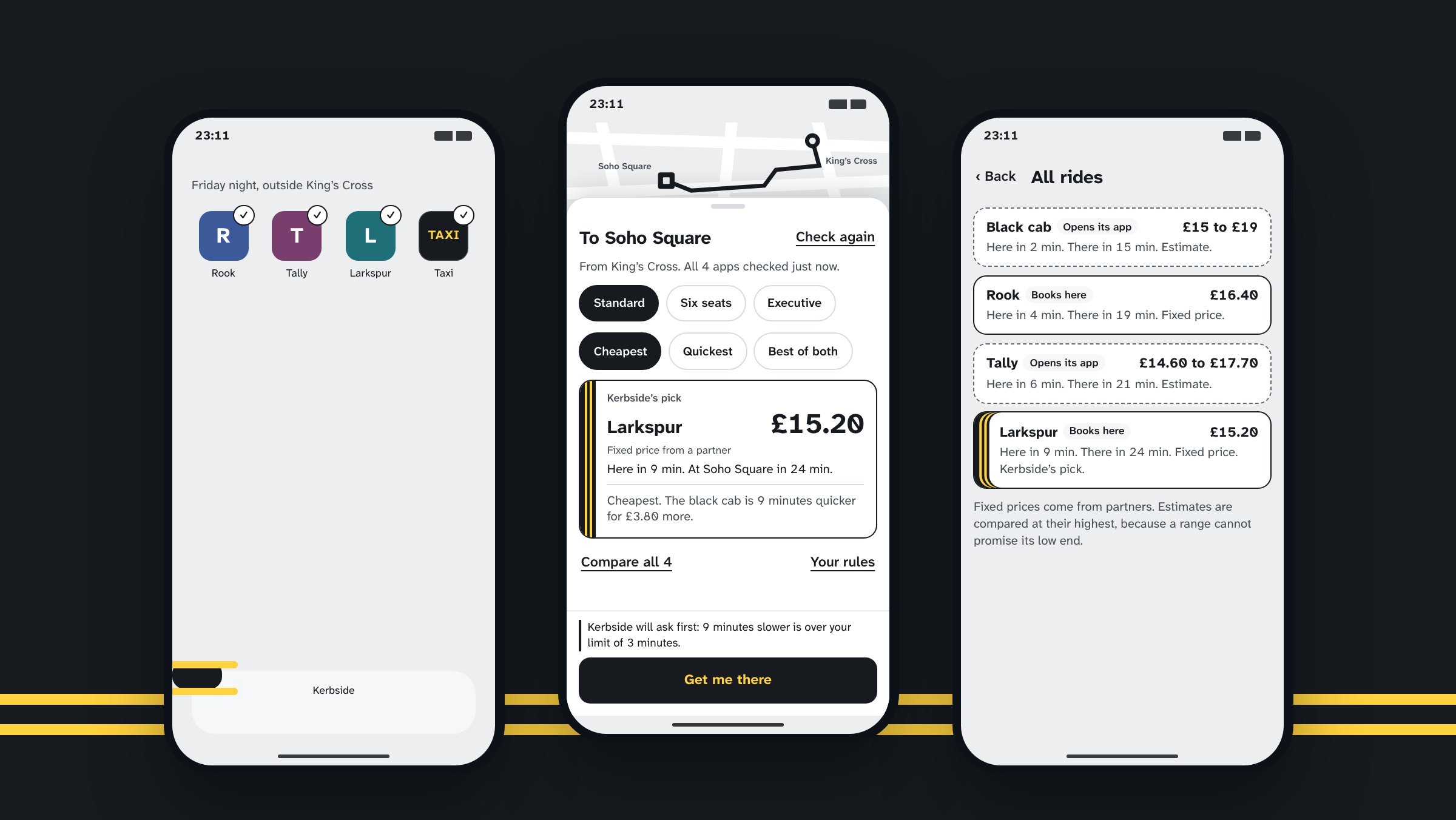
Friday night, outside King’s Cross
Before: open each app, type the trip, remember the price.
To Soho Square
Check againFrom King’s Cross. All 4 apps checked just now.
Kerbside’s pick
Larkspur
£15.20Fixed price from a partner
Here in 9 min. At Soho Square in 24 min.
Cheapest. The black cab is 9 minutes quicker for £3.80 more.
After: one pick, one reason and the button under your thumb.
Try the prototypeCheck four ride apps yourself on a phone screen, then let Kerbside do it and book within your rules.
Why the best ride is hard to find
- Lots of supply, spread across apps. London has 93,300 licensed private hire vehicles, according to the Department for Transport’s 2026 statistics. FREENOW became part of Lyft in 2025, and in 2023 Uber announced that black cabs would join its app.
- Prices move trip by trip. University of Oxford researchers analysed 1.5 million trips by 258 UK Uber drivers. After dynamic pricing arrived in 2023, passengers paid more per trip, and Uber’s average cut rose from about 25% to 29%.
So the cheapest app for one journey may not be the cheapest for the next.
A phone, in one hand, at the kerb
Steven Hoober made 1,333 observations of people using phones in streets, airports, bus stops, cafes, trains and buses. Of those touching the screen, 49% held the phone in one hand, and people changed grip often. That set the rules before any screen was drawn: big targets within reach of a thumb, text readable at a glance in the dark, and nothing that breaks when the signal drops.
| Situation | What it changes in the design |
|---|---|
| One hand, often while walking | The main action is full width at the bottom, 56 pixels tall. Every target is at least 48 pixels. |
| Outside at night | High contrast in both themes. The pick is marked by shape as well as colour. A typeface made for low-vision legibility. |
| Half an eye on the street | One pick and one line of reasoning, readable at a glance. The full list is one tap away. |
| Weak signal at a busy station | Prices say how old they are. Booking waits for signal instead of failing halfway. |
| Switching to another app | The system asks before leaving Kerbside, and the trip is filled in on the other side. |
| Phone back in the pocket | A lock screen card shows the pickup time, as Apple’s guidelines suggest for ride apps. |
| Larger text turned on | Text scales by 1.3 times and the layout reflows without cutting anything off. |
Sixteen public sources, including the law itself
Show all 16 sources, with how and when each was collected
| Source | What it shows | Based on | When |
|---|---|---|---|
| Department for Transport, taxi and private hire statistics | Licensed private hire vehicles in London and England | Licensing records, as at 1 April 2026 | Aug 2026 |
| Lyft company blog | Lyft completing its purchase of FREENOW | Company announcement | Jul 2025 |
| Uber newsroom | Black cabs joining the Uber app in London | Company announcement | Nov 2023 |
| University of Oxford | Fares and Uber’s cut after dynamic pricing | 1.5 million trips by 258 UK drivers, 2016 to 2024 | Jun 2025 |
| Uber developer terms for Europe | Showing Uber beside its competitors | Terms of use, last updated Feb 2021 | Checked Oct 2026 |
| Uber rider terms, UK | Scraping and account sharing, and who the rider contracts with | Terms of use | Checked Oct 2026 |
| Ben Edelman, then at Harvard Business School | Uber cutting off a price comparison app | Case write-up with Uber’s correspondence | Jun 2016 |
| Private Hire Vehicles (London) Act 1998, section 2 | Who may invite or accept bookings in London | Legislation, in force | Checked Oct 2026 |
| Private Hire Vehicles (London) Act 1998, section 5 | Passing a booking to another operator | Legislation, in force | Checked Oct 2026 |
| Transport for London, operator contracts guidance | The operator accepting a booking acts as principal | Regulator guidance after a High Court judgment | Apr 2022 |
| Transport for London, taxi tariffs | Published black cab meter rates | Regulated fares | In force since Apr 2024 |
| City AM | Karhoo, a London comparison app, closing | News report | Nov 2016 |
| TechCrunch | Kakao Mobility buying Splyt | News report | Mar 2023 |
| Cities Today | Bolt bookings through ChatGPT | News report | Aug 2026 |
| Steven Hoober, UXmatters | How people hold their phones in public | 1,333 observations in streets, airports, bus stops, cafes, trains and buses | Feb 2013 |
| Apple Human Interface Guidelines | Live Activities, with ride apps as the example | Platform guidance | Checked Oct 2026 |
- Comparing has been tried. Karhoo, a London comparison app, raised $250 million and closed in 2016. Comparison apps today show the options, then open the provider’s app for you to book. Even Bolt in ChatGPT sends you back to Bolt’s app to finish.
- The largest provider rules it out. Uber’s developer terms for Europe say an app may not “include any underlying Uber platform or product with competitors in any aggregated view” without its written permission.
- The law decides who books. In London, nobody may accept a private hire booking without a TfL operator’s licence. TfL’s guidance says the operator that accepts a booking contracts with the passenger “as principal”.
As I read the Act and TfL’s guidance, the moment that makes the idea worth having, “it is on its way”, is the moment the app becomes the operator, answerable for every journey it books.
Comparing and booking sit with different companies
| What exists | Compares providers | Price shown | Books for you |
|---|---|---|---|
| Comparison apps | Yes | Estimates, or prices from your own accounts | No. They open the provider’s app |
| A provider inside an AI chat, like Bolt in ChatGPT | No, one provider | An estimate | No. It hands you back to Bolt’s app |
| The largest app adding others, like black cabs on Uber | Inside one app | An upfront range | Yes, as Uber |
| Kerbside Chosen | Yes | Partner prices, with other estimates labelled | With partners, within the rider’s limits |
Four ways to make “it is on its way” true
| Option | What it costs | What happens |
|---|---|---|
| Become the operator for every ride | A licence, and answering for journeys other companies run | Every provider would have to accept its bookings |
| Hand every booking over | An extra tap on every trip | It never books anything |
| Read the rider’s own apps with an AI agent | Breaks whenever an app changes its screens | Runs into terms like Uber’s on scraping |
| Book through partners, hand over the rest Chosen | A licence, partner agreements and fewer rides it can book outright | Books only where it can stand behind the ride |
- Becoming the operator for every ride delivers the whole idea, and makes the app answerable for journeys it does not run.
- Handing every booking over is what exists. It never books anything.
- Reading the rider’s own apps with an AI agent runs into terms like Uber’s, and breaks when an app changes.
- Booking through partners and handing over the rest was the only option that books for the rider without relying on access the providers have not given.
One pick, one reason and one button under the thumb
To Soho Square
Check againFrom King’s Cross. All 4 apps checked just now.
Kerbside’s pick
Larkspur
£15.20Fixed price from a partner
Here in 9 min. At Soho Square in 24 min.
Cheapest. The black cab is 9 minutes quicker for £3.80 more.
1 The kerb line marks the pick. 2 The main button, and what it will do, sit where a thumb reaches.
All rides
Black cabOpens its app
£15 to £19Here in 2 min. There in 15 min. Estimate.
RookBooks here
£16.40Here in 4 min. There in 19 min. Fixed price.
TallyOpens its app
£14.60 to £17.70Here in 6 min. There in 21 min. Estimate.
LarkspurBooks here
£15.20Here in 9 min. There in 24 min. Fixed price. Kerbside’s pick.
Fixed prices come from partners. Estimates are compared at their highest, because a range cannot promise its low end.
3 Every ride, sorted by arrival. Solid outline for a fixed price, dashed for an estimate.
Book without asking
Book for me without askingOnly when every rule below is true
Partner rides onlyKerbside only books rides it can stand behind. Others open in their own app.
Always onPrice up to
−+Slower than the quickest by at most
−+Right now, Larkspur at £15.20: inside your rules, so Kerbside will book it and give you 5 seconds to undo.
4 Steppers instead of sliders, so each limit is exact with one thumb.
To Soho Square
Check againFrom King’s Cross. All 4 apps checked just now.
Kerbside’s pick
Larkspur
£15.20Fixed price from a partner
Here in 9 min. At Soho Square in 24 min.
Cheapest. The black cab is 9 minutes quicker for £3.80 more.
5 Booking without asking always comes with 5 seconds to undo.
- One pick, with the rest one tap away. Kerbside makes the call and shows its working, so the rider only has to agree or overrule.
- The reason fits on one line. “Cheapest. The black cab is 9 minutes quicker for £3.80 more.”
- Solid outline for a fixed price, dashed for an estimate, so the meaning never rests on colour. Estimates are compared at the top of their range.
- The main button at the bottom, with what it will do written above it. Book, ask or hand over, with the reason.
- Booking without asking is a rule the rider sets: partner rides only, under a price and time limit, with 5 seconds to undo.
To Soho Square
Check againFrom King’s Cross. All 4 apps checked just now.
Kerbside’s pick
Larkspur
£15.20Fixed price from a partner
Here in 9 min. At Soho Square in 24 min.
Cheapest. The black cab is 9 minutes quicker for £3.80 more.
Dark mode at night. Only the theme tokens change. The kerb line keeps 12.9 to 1 contrast.
To Soho Square
No signal. These prices are from 2 minutes ago.
Kerbside’s pick
Larkspur
£15.20Fixed price from a partner
Here in 9 min. At Soho Square in 24 min.
Cheapest. The black cab is 9 minutes quicker for £3.80 more.
No signal at the station. Prices say how old they are, and booking waits instead of failing halfway.
23:12
Friday
9 min Larkspur, grey hybrid saloonContactPhone back in the pocket. The pickup time on the lock screen, one action, gone after the ride.
No signal is normal in a station, so prices say how old they are and booking waits. Handing over goes through the phone’s own “Open in” prompt with the trip filled in. Once the phone is back in a pocket, the pickup time sits on the lock screen.
A small design system, built from tokens
Colour in light mode. Each pair is a token, with its contrast ratio worked out from tokens.json at build time
17.3 to 1
8.7 to 1
17.3 to 1
5.7 to 1
12.0 to 1
12.0 to 1
5.4 to 1
5.8 to 1
Colour in dark mode. Only the theme tier changes
16.1 to 1
9.1 to 1
16.1 to 1
5.5 to 1
12.9 to 1
12.9 to 1
7.8 to 1
8.5 to 1
Type: Atkinson Hyperlegible Next, with fixed-width numbers for prices and times
£15.20Price, 34
To Soho SquareTitle, 22
Here in 9 min. At Soho Square in 24 min.Body, 17
Fixed price from a partnerCaption, 13
The same components in both themes
Light mode
Kerbside’s pick
Larkspur
£15.20Fixed price: solid outline
TallyOpens its app
£14.60 to £17.70Estimate: dashed outline
Dark mode
Kerbside’s pick
Larkspur
£15.20Fixed price: solid outline
TallyOpens its app
£14.60 to £17.70Estimate: dashed outline
- Three tiers of tokens, in the Design Tokens Community Group format. Components only use the theme tier, so dark mode never touches a component.
- A palette from the kerb. Kerb yellow sits almost opposite cool asphalt grey on the colour wheel, so one accent marks the pick. It is too pale for white, so it only sits on dark asphalt.
- Atkinson Hyperlegible Next, made by the Braille Institute for low vision, with fixed-width numbers so prices do not jump.
How it would make money without bending the pick
Partners would pay a fee for each ride booked through Kerbside. That creates a pull towards favouring partners, so the pick is worked out on price and time first. Partner status only decides whether Kerbside books or hands over. There are no “2 cars left” or “most people choose this” prompts. Kerbside earns more only by signing up more partners.
How I would know it works
| Measure | Why it matters | What good looks like |
|---|---|---|
| Time from opening the app to a booked ride | The point is to replace checking four apps by hand | Seconds, against minutes by hand |
| Picks taken without opening the full list | Shows whether one pick and one reason are enough | Most picks taken as they are |
| Undo rate on bookings made without asking | A high rate means the rules are too loose or the pick is wrong | Low and falling |
| Complaints about a ride booked without asking | The trust the whole idea rests on | As close to none as possible |
| Trips booked inside Kerbside | Partner coverage, and so the business | Rising as partners join |
What I got wrong first
- It booked everything. The law and the providers’ terms cut that back to partner rides only.
- It used sliders. On a phone held in one hand, a slider is hard to set exactly. Steppers replaced them.
- It was a web page. It showed how the pick worked, but nothing about using it on a phone. I rebuilt it as an app with its own design system.
- The button hid the reason. On a real phone screen, the pinned button covered the line explaining the pick. A shorter map and a smaller header fixed it.
- It opened on the wrong default. It now opens on “cheapest”, the question the rider has just been asking.
What the sources could not tell me
The research shows what the market and the law allow. It does not show how riders choose. The first test I would run is at a station: five riders book the same trip by hand and with Kerbside. I would time both and ask whether they would have overruled the pick. The legal reading is my own, and I would check it with a licensing specialist before building.
If you see a flaw in how I read the sources, tell me.
Sources were checked against each organisation’s own page in October 2026. Provider names, prices and drivers in the prototype are made up.
If this is relevant to a role you are hiring for, I am glad to walk through the screens, the design system and how I read the sources.