In short
- The problem
- People hand tasks to AI agents with one Allow button. What they mean has four parts, and nothing records them beyond money.
- My role
- Self-initiated. I did the research, the design, the design kit and the prototype myself.
- What the research showed
- People hand over tasks in steps and rarely check AI output, and spending limits exist but nothing covers an address, a message or a promise. That shaped the four answers and the lock-screen ask. From 14 published sources.
- Key decision
- A four-part permission the person sets once, the agent checks before each action and the business keeps as the record. Drawn as a kit that takes each app’s look and keeps the four answers the same.
- The trade-off
- One extra step before the agent starts, in return for not having to watch it.
- Status
- A concept with a playable prototype. The design has not yet been tested with people. Next: five people, then a real agent given written limits.
A concept built on published research, with a playable prototype. Every figure links to the organisation that collected it. The design has not yet been tested with people.
Contents
Mechanical keyboard
Very good condition. Collection only.
£60
Let your agent reply to buyers?
It will message buyers for you while the listing is live.
Before: one button answers one question, and covers every message after it.
Mechanical keyboard
Very good condition. Collection only.
£60
Before your agent replies to buyers
Selling the keyboard
On its own
- Answer questions about it
Ask me first
- Accept a lower offer Can’t be undone
- Share my home address Can’t be undone
- Agree a pickup time
Never
- Say I am home
Ends
- When it sells
Anything that can’t be undone starts under Ask me first. You can move it.
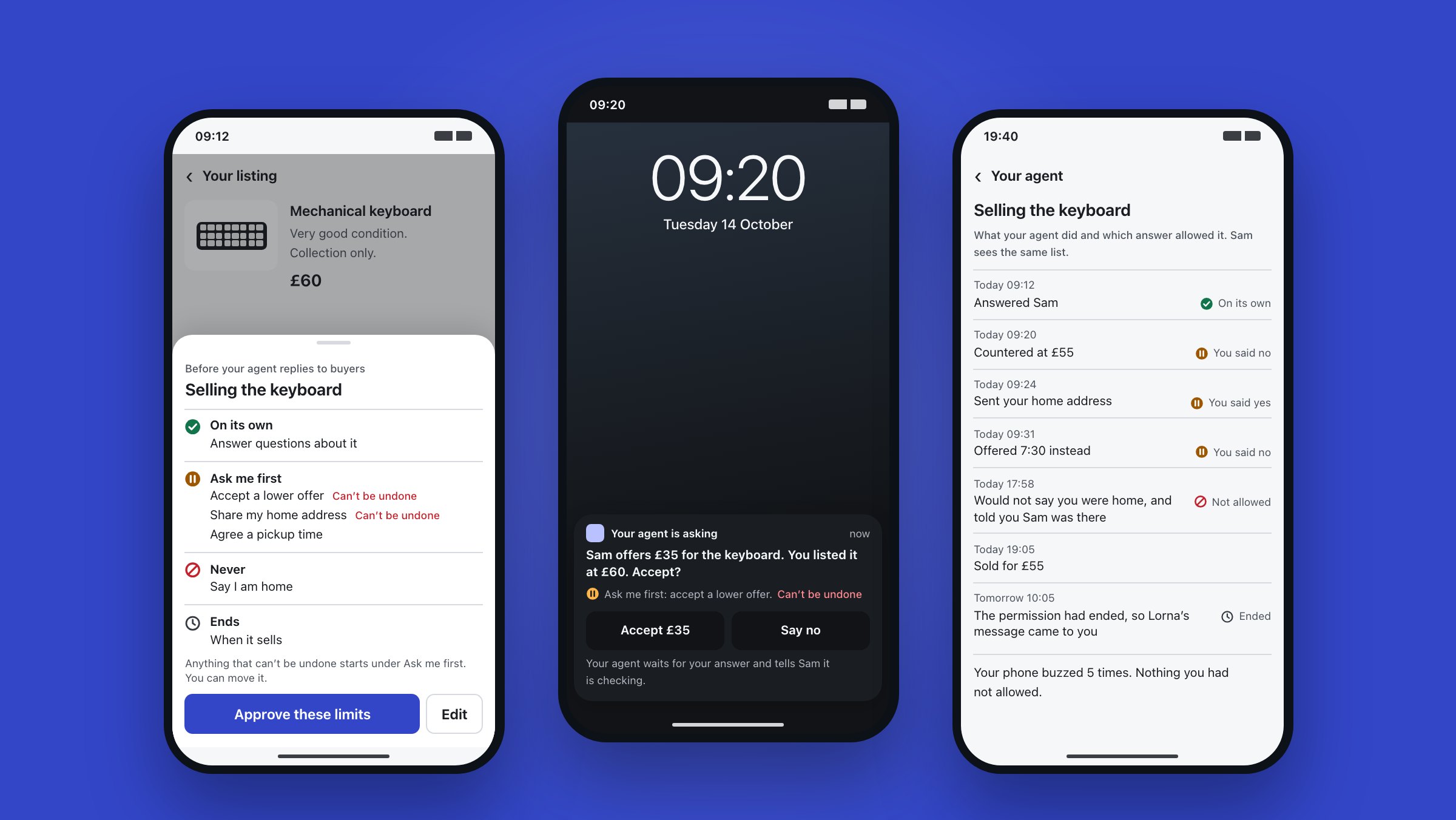
After: four answers, set once, in the words of the task.
Try the prototypeWatch one tap go wrong, then sort what the agent may do and see every consequence change.
One bad screen, or a gap in how agents are built?
Use is already wide. More than half of UK adults (54%) use AI tools, according to Ofcom. Adobe measured a 693% rise in visits to US retail sites from generative AI tools over the 2025 holidays. And agents are moving from answering to acting: they book, buy and reply, for a person, with a business on the other end.
Five interviews could not tell me whether this was one bad screen. So I went to organisations that had already measured it at scale.
Fourteen sources, chosen for how their data was collected
Each source collected its own data, said how and was published in the last two years. I set surveys, which record what people say, against traffic, audit and fraud data, which record what happens.
Show all 14 sources, with how and when each was collected
| Source | What it measured | Based on | When |
|---|---|---|---|
| Ofcom, Adults’ Media Use and Attitudes | How many UK adults use AI tools | 7,533 UK adults | Sep to Nov 2025 |
| UK Government, Public attitudes to data and AI, wave 4 | How people in the UK feel about AI | 5,147 UK adults | Jul to Aug 2024 |
| Pew Research Center | How much control Americans want over AI | 5,023 US adults | Jun 2025 |
| University of Melbourne and KPMG | Trust in AI and how people check it | 48,000+ people in 47 countries | Nov 2024 to Jan 2025 |
| Accenture Consumer Pulse | What people would hand to an AI agent | 25,590 people in 16 countries, including the UK | Jan 2026 |
| Global Payments, with The Lantern | The share of purchases people expect agents to make | 8,027 people in 7 markets, including the UK | May 2026 |
| Adobe Analytics | Visits to US retail sites from generative AI tools | Over 1 trillion site visits | Nov to Dec 2025 |
| Visa Intelligent Commerce | Agent payments with limits the person sets | Product launch | Apr 2025 |
| Mastercard Agent Pay | Agent payments from registered agents | Product launch | Apr 2025 |
| Visa Trusted Agent Protocol | How a shop recognises a trusted agent | Open framework, built with Cloudflare | Oct 2025 |
| Imperva Bad Bot Report | How much web traffic is automated | Traffic across Imperva’s network | 2025 report |
| WebAIM Million | Accessibility failures that also confuse agents | The top 1,000,000 home pages | 2026 report |
| Gartner | Why agentic AI projects get cancelled | Analyst forecast and a poll of 3,412 people | Jun 2025 |
| UK Finance Annual Fraud Report | UK fraud losses and where fraud starts | UK banking industry data | May 2025 |
- People hand over tasks in steps. Accenture asked 25,590 people in 16 countries. Three in four would let an agent handle routine tasks, one in three would let it choose a purchase if they approved before paying, and fewer than one in ten would let it buy alone.
- People will not watch closely. Only 46% are willing to trust AI, in the University of Melbourne and KPMG study of more than 48,000 people. Yet 66% of people using AI at work rely on its output without checking it.
- Limits exist, but only for money. Visa and Mastercard both launched agent payments in April 2025, with limits the person sets. The September incident involved no payment at all: an address, a message and an offer.
- The other side cannot tell what was allowed. Imperva found 51% of web traffic is automated, so many sites treat automation as a threat. When an agent’s action goes wrong, there is nothing to show what the person agreed to.
The industry defines the agent and leaves out what the person allowed
| Party | Being built | Missing |
|---|---|---|
| The person | Spending limits on agent payments, from Visa and Mastercard | A way to say what the agent may do beyond spending: what to share, what to agree and when to stop |
| The agent | Verified identity and purchase intent, so shops can tell it from a bad bot | Pages it can read: most of the top million home pages fail basic accessibility checks |
| The business | Tools to separate trusted agents from the bots behind most web traffic | A record of what the person allowed, for when something goes wrong |
No single source says this. Read together, they show the industry agreeing who an agent is and how much it may spend. What the person agreed to beyond money has no shape. It lives in one tap.
Four ways to hand over a task
| Option | What it costs | What happens |
|---|---|---|
| One Allow button | Nothing up front | Covers every later action, including ones the person never meant |
| Ask before every action | An interruption at every step | People learn to tap yes without reading |
| Spending limits only | Already built into agent payments | Nothing for an address, a message or a promise |
| A scoped permission Chosen | One step before the agent starts, and agents and businesses have to read it | Limits set once and checked before every action |
- One Allow button is quick, and covers actions the person never meant.
- Asking before every action sounds safe. Given how few people check AI output, I expect it would turn into tapping yes without reading.
- Spending limits do nothing for an address, a message or a promise.
- A scoped permission costs one step before the agent starts. It was the only option that matched how people say they hand over tasks.
Four answers, set once, checked before every action
Mechanical keyboard
Very good condition. Collection only.
£60
Before your agent replies to buyers
Selling the keyboard
On its own
- Answer questions about it
Ask me first
- Accept a lower offer Can’t be undone
- Share my home address Can’t be undone
- Agree a pickup time
Never
- Say I am home
Ends
- When it sells
Anything that can’t be undone starts under Ask me first. You can move it.
1 Set once. The card opens where the task starts, with the risky actions already under Ask me first.
09:20
Tuesday 14 October
Your agent is askingnow
Sam offers £35 for the keyboard. You listed it at £60. Accept?
Ask me first: accept a lower offer. Can’t be undone
Your agent waits for your answer and tells Sam it is checking.
2 Asked on the lock screen. Who, what, which answer it hit and whether it can be undone, with the answer one tap away.
The seller’s agent replies here
- It can answer questions about the keyboard.
- It asks the seller before agreeing a price or a time, or sharing an address.
- Until the keyboard sells.
Would you take £35?
Seller’s agentI need to check that with the seller. I’ll reply here.
Seller’s agent, after askingThanks, but the lowest I can do is £55.
Message
3 The other side sees what is covered. What the agent can agree alone, and what needs the seller. The Never list stays private.
Selling the keyboard
What your agent did and which answer allowed it. Sam sees the same list.
- Today 09:12Answered SamOn its own
- Today 09:20Countered at £55You said no
- Today 09:24Sent your home addressYou said yes
- Today 09:31Offered 7:30 insteadYou said no
- Today 17:58Would not say you were home, and told you Sam was thereNot allowed
- Today 19:05Sold for £55
- Tomorrow 10:05The permission had ended, so Lorna’s message came to youEnded
Your phone buzzed 5 times. Nothing you had not allowed.
4 One record for both sides. Every action, and the answer that allowed it.
- The card is set where the task starts, in the words of the task. Anything that cannot be undone starts under Ask me first, so the safe answer is the default.
- The agent checks every action against it. Anything under Ask me first pauses the task and asks.
- The other side sees what is covered: what the agent can agree alone, what needs the person and when it ends. The Never list stays private, because it says more about the person than they chose to share.
- One record for both sides, so if something goes wrong, the person and the business look at the same thing.
- Every consequence is shown before it is approved, following Microsoft’s guidelines for human and AI interaction.
Try the prototypeTry three tasks, move the answers around and see what changes.
The ask has to work from a lock screen
People hand over tasks because they are busy, so the agent needs them at a moment they are doing something else. The ask is a notification that can be answered without opening anything, one question at a time. Until the person answers, the agent waits and tells the other side it is checking. Every ask costs attention, which is why the prototype counts buzzes.
| Moment | What it changes in the design |
|---|---|
| The person is out when the agent needs them | The ask is a notification that can be answered from the lock screen, without opening any app. |
| A glance, not a read | One question per notification. It names who, what, the answer it hit and whether it can be undone. |
| Every buzz costs attention | The prototype counts buzzes. Asking about everything is the failure the options ruled out. |
| Setting up happens mid-task | The card opens as a sheet inside the app where the task starts, already filled in from the task. |
| Small screen, one hand | Every target is at least 48 pixels. Each answer has a mark and a name, never colour alone. |
| No answer yet | The agent waits and tells the other side it is checking. It never takes silence as a yes. |
A small kit that takes each app’s look and keeps the answers the same
The four answers. Locked: each has a shape, a colour and a name, and looks the same in every app. Contrast is worked out from tokens.json at build time
Dark: #5BD196 on #1A1D22, 8.9 to 1
Dark: #FFB547 on #1A1D22, 9.6 to 1
Dark: #FF8A90 on #1A1D22, 7.5 to 1
Dark: #B4BAC2 on #1A1D22, 8.6 to 1
The same card in three made-up hosts. The surface, type, corners and button colour follow the host. The answers do not change
A marketplace
Before your agent replies to buyers
Selling the keyboard
On its own
- Answer questions about it
Ask me first
- Accept a lower offer Can’t be undone
The same marketplace in dark mode
Before your agent replies to buyers
Selling the keyboard
On its own
- Answer questions about it
Ask me first
- Accept a lower offer Can’t be undone
A grocer, Fernway
Before your agent does the weekly shop
Reordering the weekly shop
On its own
- Reorder my usual items
Never
- Go over £90
A restaurant, The Linden
Before your agent books the table
A birthday dinner for six
Ask me first
- Pay a deposit Can’t be undone
Never
- Go over £45 a head
The card will live inside other companies’ apps: a marketplace, a restaurant’s booking page, a grocer’s checkout. So the kit has two kinds of token.
- Host tokens follow the app: surface, text and button colours, corners and typeface.
- Answer tokens are locked. Each answer has a shape, a colour and a name that look the same everywhere, so people learn them once.
- One rule for hosts: any surface works as long as every answer keeps at least 4.5 to 1 contrast against it. All four pass in light and dark mode.
How I would know it works
| Measure | Why it matters | What good looks like |
|---|---|---|
| People who change at least one default before approving | Shows they read the card and it matches their task | Some do, and nobody has to change everything |
| Asks answered from the notification | The ask has to work while the person is busy | Most, without opening the app |
| Buzzes per task | Too many and people tap yes without reading | Three or fewer on a common task |
| Agent actions outside the four answers | The card is only worth having if the agent keeps to it | None, in a test with a real agent |
| Disputes where nobody can tell what was allowed | The record is meant to settle this | None, because both sides see the same record |
What changed as I built it
- The ask was a panel on a web page, like a form. I redrew it as a phone notification, because that is where the person is when the agent needs them.
- The answers were words only. Once the card had to sit inside other apps, each answer needed a mark and a colour that stay the same everywhere.
Desk research found the gap, and cannot prove the fix
None of this shows that a person would fill in four answers, or that a real agent would keep to them. Next, I would test the card with five people, then give an agent written limits and see where it breaks them.
Before recruiting, I tested whether AI personas could stand in for those five people. They agreed with each other far more than people do, and none of them tapped Allow always.
If you see a flaw in how I read the sources, tell me.
Figures were checked against each organisation’s own publication in October 2026. The Gartner and WebAIM figures were checked against two independent reports of the original, because the original pages would not load for me.
If this is relevant to a role you are hiring for, I am glad to walk through the sources and how I read them.